The various uprisings around the globe have given me some uncomfortable thoughts, largely around the possibility that these could have been brought about by agencies outside those countries.
Looking closely at those countries, Tunisia, Egypt, Bahrain and now Libya and Iran, could this be the case of another ‘Operation Cyclone’ but using peaceful protest as the catalyst. Another article questions the input of Gene Sharp, especially by some regimes.
I truly hope that these are spontaneous events, but will wait for the Wiki leaks to prove otherwise!
Showing posts with label power. Show all posts
Monday, February 21, 2011
Thursday, November 11, 2010
Austerity revisited…
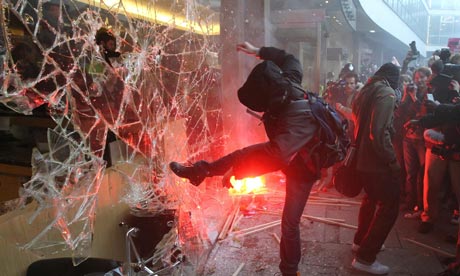
According to this report (OK, so it is actually a syndicated story, hence the references to the US and ‘soda cans’) the UK students protest against the increase in student tuition fees was
the largest street protest yet against the government's sweeping austerity measures.
So yet again I am forced to define what austerity (as seen before in my other blog re this) although I am using a slightly different definition here, the other is still relevant
In economics, austerity is a policy of deficit-cutting, lower spending, and a reduction in the amount of benefits and public services provided. Austerity policies are often used by governments to reduce their deficit spending while sometimes coupled with increases in taxes to pay back creditors to reduce debt.
Governments around the world (the UK and NZ seem to be copying each other) are mainly playing the austerity policy game and at last someone has the sense to publicly challenge this. True, you cannot just print more money, but you do need to think about why you are introducing these measures.
Some of the quotes from the AP article state quite succinctly why people have sound arguments
"Politicians don't seem to care, they should be taking money from people who earn seven-figure salaries, not from students who don't have any money."
"We will not tolerate the previous generation passing on its debts to the next, nor will we pick up the bill to access a college and university education that was funded for them”
So, rather than this being a ‘class war’(as suggested by the likes of the right wing Sky TV News) this is a generation war, those than benefited from the boom years are now being challenged, rightly in my opinion, on the justice of their decisions. Another article provides a clearer insight into the political arguments, the back tracking of the Liberals, conveniently changing policy direction to become bed mates with the Tories. Not unlike the Maori party and their cosy relation with National here in NZ – about time people begin to see through that marriage of convenience.
And to finish - if Austerity involves increasing taxes to repay debt, exactly why is the New Zealand government borrowing money to pay for tax cuts?
Monday, November 1, 2010
New Zealand’s Lost Villages
These are all over the place and I’ve visited quite a few. They all share similar traits; they all have seen better days, they all had prosperous industries and, according to one of my work mates, they should have all been bull dozed a long time ago!
Today I visited Te Mahoe, a small settlement in the eastern Bay of Plenty. It is near another town, Kawerau, which itself has seen better days. Te Mahoe apparently was established as a village for two groups of people, those who built the nearby dam and those who originally ran the power plant driven by the water from the dam. But, we now live in a modern, automated age, with the power plant now seemingly run from afar and bereft of actual employees, so Te Mahoe sits silently in the valleys, a small collection of well kept homes, but little else. The small primary school could be the next in line (especially as Kawerau’s schools are to be consolidated into fewer and bigger schools).
What future does Te Mahoe have? No actual sign of work places in the area, the teachers at the school (as well as many of the students) travel to there. It is like a scale model of Turangi or Mangakino, similarly constructed for hydroelectric; Turangi, by virtue of proximity to the ski fields and trout fishing, as well as two large prisons, at least looks like a town that will survive.
There are others of this ilk – Te Kaha, dairy factory gone, tourist ventures failed, it sits in decline; Kaingaroa, once a thriving forest settlement, now it is a collection of near derelict homes – mostly with families living in them. A recent TV news report showed how in the Central North Island sections of land were available for free, as nobody wanted those house section in those villages
So, does the outside world actually know of these places – what is more troublesome is that few in New Zealand really care about these places or the people in them, who sit between the metaphorical rock and a hard place. Whilst we fret over ‘The Hobbit’, there are sections of New Zealand with substandard housing, long term unemployment and no prospect of changes or improvement. Overseas the ‘heritage’ angle would be used, considering these required saving for the benefit of the nation. Maybe the people should be considered the national treasure?
Wednesday, October 20, 2010
Turning green
The first thought was have I turned green; quite by chance I haven’t eaten any meat for nearly two days, so I must have reduced my carbon footprint considerably, seeing as the production of meat is one of the most energy consuming activities going (as is the refrigeration used to keep it in an edible state). However, the lengthy shower where I have these thoughts probably makes up for any savings.
I also got to thinking about renewable energy sources. I had seen the previous day that the proposed Severn Barrage had been cancelled in favour of several nuclear power stations. As a kid I loved nuclear, it was modern age, it was a symbol of power and it seemed all too good to be true – that was before Three Mile Island and Chernobyl – as an adult I am far more cautious.
Now I can understand that there are ecological reasons behind the cancellation, but are there as big ecological reasons as nuclear waste or accidental radiation release? It is about time governments started selling their green credentials a bit more and actually looked at renewable's in a more proactive manner.
Subscribe to:
Posts (Atom)